These Tiny Worm-Like Robots Can Build Absolutely Huge Structures Including Spaceships
Small robots making big structures
They scoot around like tiny inch worms but these robots can build absolutely huge structure
- Massachusetts Institute of Technology researchers are working on tiny robots that can build huge structures.
- NASA and Airbus are both interested in potentially using these robots in a new form of manufacturing.
- The robots view themselves as part of the structure, rather than as separate entities building a structure.
It's no simple task to build a spacecraft or an airplane. Usually, the pieces are built at separate facilities, shipped via massive cargo planes, and then put together at final assembly. It's time consuming and expensive work. But a new form of manufacturing robots—which build structures like a kid with a bin of Legos—could change that.
These funny little helpers are called assembler robots. They look like robotic arms that pull themselves across a structure. In fact, they view themselves as part of the structure, not just an object that that they're helping to build
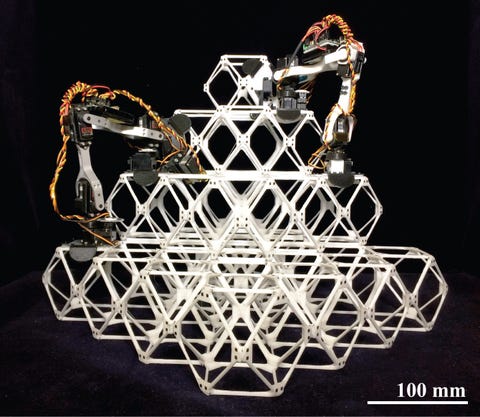
Typically robots are separated into two separate buckets: those made of expensive, custom parts to complete very specific tasks like factory assembly of cars; and those made of inexpensive, mass-produced parts that don't perform as well. The assembler robots are a whole new class, according to Gershenfeld. They're simpler than those factory bots, more capable than the cheap guys and still have the capacity to build huge structures like airplanes, rockets, or bridges.
As a nod to the 2008 Pixar film Wall-E, Jenett named the assembler robots BILL-E, which stands for Bipedal Isotropic Lattice Locomoting Explorer.


One of the perks of the assembler robots is that they don't require expensive navigation systems to get around a space like a warehouse robot might. Instead, the robots move in relation to the pieces it's building, which are called voxels. As voxels are added, the tiny robots adjust their positioning relative to the structures. This is cost-effective and it also makes it quicker to repair what the robots have built.
Moving around like inchworms, clamping onto the voxels by opening and closing their V-shaped bodies, the tiny robots can each count their steps on the structure they're building. That means it's easier to go back and fix manufacturing errors as you go, Gershenfeld explained.
“It’s missing most of the usual control systems, but as long as it doesn’t miss a step, it knows where it is," he said.
When it comes to space stations and lunar habitats, the robots would essentially live on the structure, completing continuous repairs.
“For a space station or a lunar habitat, these robots would live on the structure, continuously maintaining and repairing it,” says Jenett.
Jenett, who has already built several proof-of-concept designs and corresponding voxel designs with latching mechanisms that allow each to be easily added or removed from its neighbors, says the precision has been built into the structure, not the robots.
“That’s different from all other robots," he said. "It just needs to know where its next step is.”
Special software allows groups of the assembler robots to work together, speeding up manufacturing. It allows each unit to coordinate its work and keep out of the way of other robots. NASA and Airbus SE, both sponsors of the research, are interested in potentially adopting the technology.


Replies