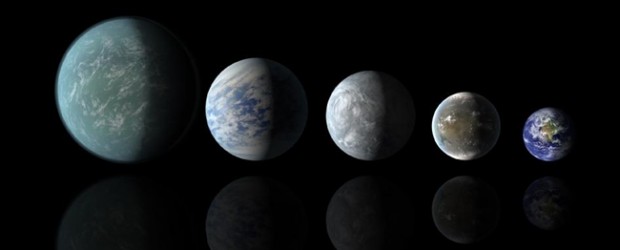
Continuing its hunt for habitable planets, Kepler mission has discovered 3 new planets in “habitable zones” of their solar system, NASA revealed on Thursday, April 18, 2013. Two of the newly discovered planets are most Earth-like planets found to date. They belong to system Kepler-62, which is located 1,200 light-years from Earth and are called Kepler-62e, 62f, whereas third one is Kepler-69c in Kepler-69 system located 2,700 light-years from Earth. All three are categorized super-Earth-sized and being in habitable zone means their distance from corresponding stars might have allowed water to exist.
Whether life could exist on these planets or not is yet unknown, yet NASA scientists claim they are now one step closer to find out Sun-Earth twins. John Grunsfeld, associate administrator of the Science Mission Directorate at NASA Headquarters in Washington said,
“The Kepler spacecraft has certainly turned out to be a rock star of science. The discovery of these rocky planets in the habitable zone brings us a bit closer to finding a place like home. It is only a matter of time before we know if the galaxy is home to a multitude of planets like Earth, or if we are a rarity.”
The star in Kepler-62 system is smaller and cooler than the sun. Kepler-62f is just 40 percent larger than Earth, making it the exoplanet closest to the size of our planet known in the habitable zone of another star. Kepler-62f is likely to have a rocky composition. Kepler-62e, orbits on the inner edge of the habitable zone and is roughly 60 percent larger than Earth.
Orbiting its star every 122 days, Kepler-62e was the first of these habitable zone planets identified. Kepler-62f, with an orbital period of 267 days, was later found by Eric Agol, associate professor of astronomy at the University of Washington and co-author of a paper on the discoveries published in the journal Science. The size of Kepler-62f is now measured, but its mass and composition are not. However, based on previous studies of rocky exoplanets similar in size, scientists are able to estimate its mass by association. William Borucki, Kepler science principal investigator at NASA’s Ames Research Center at Moffett Field, Calif., and lead author of the Kepler-62 system paper in Science said,
“The detection and confirmation of planets is an enormously collaborative effort of talent and resources, and requires expertise from across the scientific community to produce these tremendous results. Kepler has brought a resurgence of astronomical discoveries and we are making excellent progress toward determining if planets like ours are the exception or the rule.”
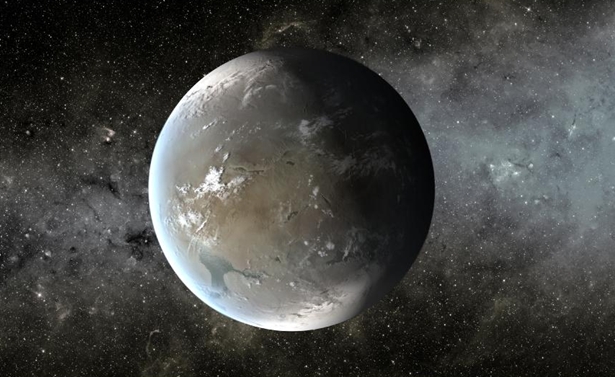
The artist’s concept depicts Kepler-62f, a super-Earth-size planet in the habitable zone of a star smaller and cooler than the sun, located about 1,200 light-years from Earth in the constellation Lyra. Image credit: NASA Ames/JPL-Caltech
The two habitable zone worlds orbiting Kepler-62 have three companions in orbits closer to their star, two larger than the size of Earth and one about the size of Mars. Kepler-62b, Kepler-62c and Kepler-62d, orbit every five, 12, and 18 days, respectively, making them very hot and inhospitable for life as we know it. The five planets of the Kepler-62 system orbit a star classified as a K2 dwarf, measuring just two-thirds the size of the sun and only one-fifth as bright. At seven billion years old, the star is somewhat older than the sun. It is about 1,200 light-years from Earth in the constellation Lyra.
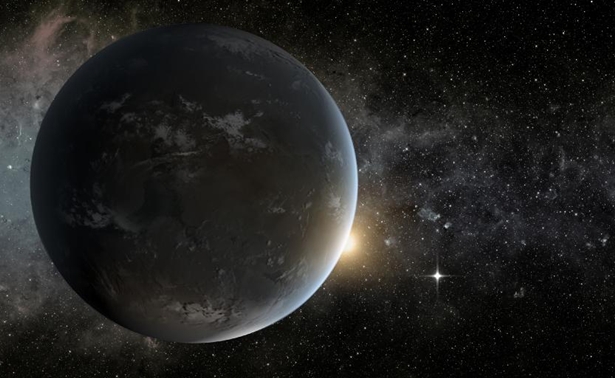
The artist’s concept depicts NASA’s Kepler misssion’s smallest habitable zone planet. Seen in the foreground is Kepler-62f, a super-Earth-size planet in the habitable zone of a star smaller and cooler than the sun, located about 1,200 light-years from Earth in the constellation Lyra. Image credit: NASA Ames/JPL-Caltech
Kepler-69c is the third planet, 70 percent larger than the size of Earth. It orbits in the habitable zone of a star similar to our sun. Astronomers are uncertain about the composition of Kepler-69c, but its orbit of 242 days around a sun-like star resembles that of our neighboring planet Venus.
Kepler-69 system has another planet known as Kepler-69b. It is more than twice the size of Earth and whizzes around its star every 13 days. The Kepler-69 planets’ host star belongs to the same class as our sun, called G-type. It is 93 percent the size of the sun and 80 percent as luminous and is located approximately 2,700 light-years from Earth in the constellation Cygnus. Thomas Barclay, Kepler scientist at the Bay Area Environmental Research Institute in Sonoma, Calif., and lead author of the Kepler-69 system discovery published in the Astrophysical Journal said,
“We only know of one star that hosts a planet with life, the sun. Finding a planet in the habitable zone around a star like our sun is a significant milestone toward finding truly Earth-like planets.”
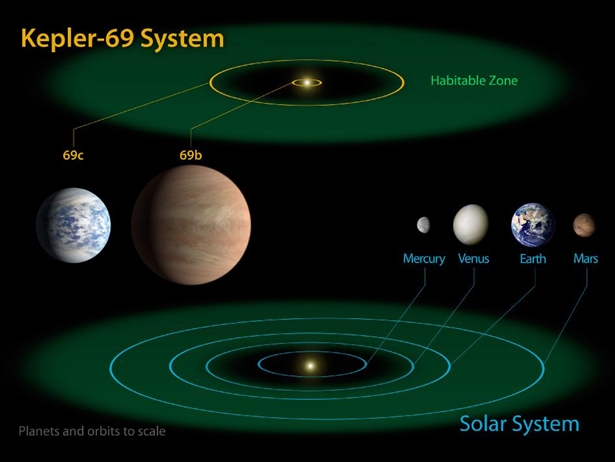
The diagram compares the planets of the inner solar system to Kepler-69, a two-planet system about 2,700 light-years from Earth in the constellation Cygnus. The two planets of Kepler-69 orbit a star that belongs to the same class as our sun, called G-type. Image credit: NASA Ames/JPL-Caltech
Media briefing hosted by NASA:
The exoplanet transit method
Kepler mission uses the exoplanet transit method in its quest for Earth-like planets. When a planet candidate transits, or passes in front of the star from the spacecraft’s vantage point, a percentage of light from the star is blocked. The resulting dip in the brightness of the starlight reveals the transiting planet’s size relative to its star. Kepler has detected 2,740 candidates so far by using the transit method. With the help of various analysis techniques, ground telescopes and other space assets, 122 planets have been confirmed. Find more about it: measuring a distant planet’s transit — The Exoplant Transit Method.
Hunting for habitable planets, the Kepler space telescope continuously measures the brightness of more than 150,000 stars. Ames research center is responsible for Kepler’s ground system development, mission operations, and science data analysis. NASA’s Jet Propulsion Laboratory in Pasadena, Calif., managed Kepler mission development.
Featured image: NASA Ames/JPL-Caltech
Relative sizes of Kepler habitable zone planets discovered as of April 18, 2013. Left to right: Kepler-22b, Kepler-69c, Kepler-62e, Kepler-62f and Earth (except for Earth, these are artists’ renditions).


Comments